Sentinel Pocket: the AI in your own Chrome sorts server security alerts, and your logs stay on your machine
Sentinel Pocket is a web app that sorts server security alerts into three piles: noise, check or danger. Our CTO Joy Ahmed built it for the #BuildHybridAI 2026 hackathon.
Watch the 3-minute demo on YouTube · Try it live · Devpost entry
The problem
We run a small production server with a watchdog on it. In ten days it raised over fifteen hundred security alerts. Almost all of them were nothing: backups, app installs, admin work. But someone still had to read each one, because one of them could be a real break-in.
Pasting those logs into a cloud chat was not an option. They hold IP addresses, commands, user names and secret paths.
What it does
Sentinel Pocket judges each alert with Gemini Nano, the model built into Chrome, through Firebase AI Logic. The model runs on the machine, so it is fast, free, and works offline.
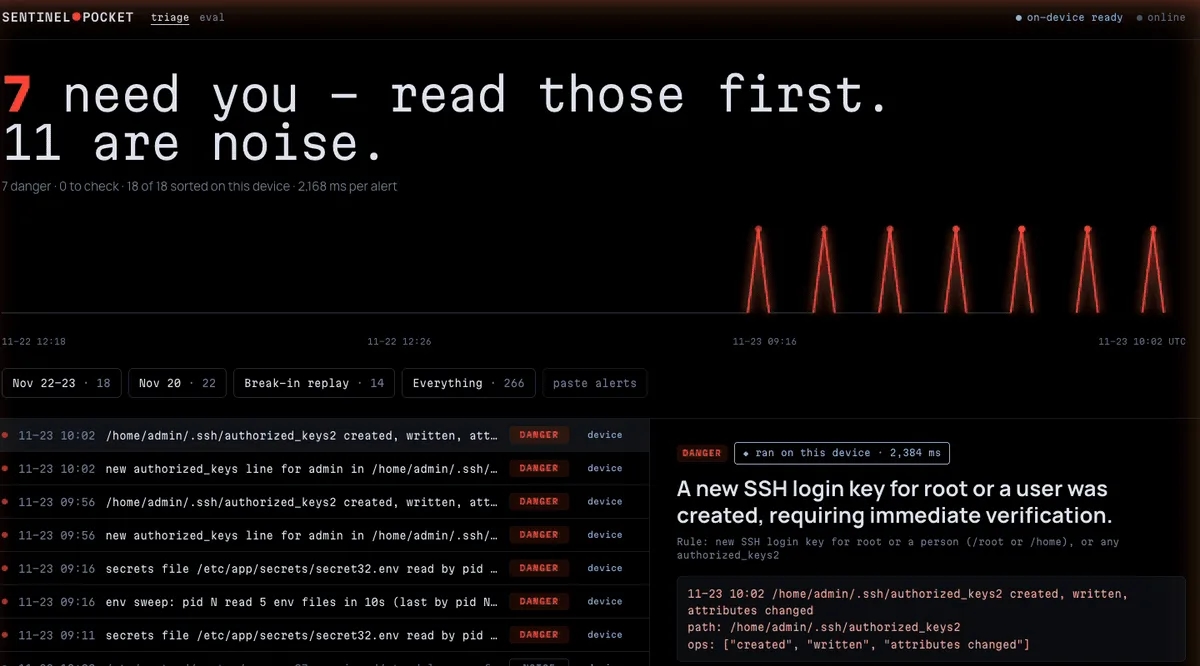
- Every alert gets a verdict, one plain reason and one next step.
- A headline says how many alerts need you and how many you can sleep through.
- Every answer shows where it ran: on this device or in the cloud.
- "Investigate deeper" sends related alerts to a bigger cloud model. Before anything leaves, you see a preview with IP addresses, names, apps and paths replaced. Nothing is sent until you click.
- The
/evalpage runs the whole labelled set in the browser and shows the score.
On a browser with no Gemini Nano, the hybrid model may send at most 3 scrubbed alerts a day to the cloud by itself. Past that, only when you click.
How it decides
Each alert goes through two passes on the device, with a guardrail written in code.
- Pass 1: Gemini Nano judges the alert on its own, without notes about the server.
- Hard signs: code checks the alert for 11 intruder signs, for example a new SSH login key for root, a new account with uid 0, or a known miner. A hard sign always means danger.
- Pass 2: only if pass 1 said danger or check and no hard sign fired. Gemini Nano reads notes about what is normal on the server, and may only lower the verdict to noise.
Why two passes: with the notes in a single pass, the model let them excuse real intruder signs and caught only 10 of 21 dangers. Without the notes it caught 20 of 21 but raised 45 false alarms. Splitting the two jobs fixed both.
Results
Joy labelled 266 alerts: 252 real alerts from our server, scrubbed, and 14 replays of a real break-in pattern. 245 are noise and 21 are danger. Every alert was answered on the device (Apple M1 Max, Chrome 158, Gemini Nano), measured on 23 November 2026.
- All 266 alerts: 99.2% exact, 19 of 21 dangers caught, 0 false alarms.
- Held-out half (odd ids, never used for tuning): 98.5% exact, 8 of 10 dangers caught, 0 false alarms.
- Speed: about 2.5 seconds per alert, both passes together.
Limits
- It missed 2 dangers, both in the held-out half. Both are signs the hard-sign code does not
cover yet. The misses are written up in
docs/EVAL.mdin the repo. - The labelled set is small: 266 alerts, only 21 of them danger, from one server.
- The cloud side runs on the Firebase AI Logic free tier, about 20 requests a day shared by every visitor of the hosted site. On-device sorting and the rules keep working when it is used up.
Links
- Live app: sentinel-pocket.web.app
- Source code (Apache-2.0): github.com/joyahmed/sentinel-pocket
- Demo video: youtu.be/bxhhcbc0pzo
- Devpost: devpost.com/software/sentinel-pocket
More from Insights
2026-11-27
Velkrys: one fast file explorer that works the same on Windows, Mac and Linux
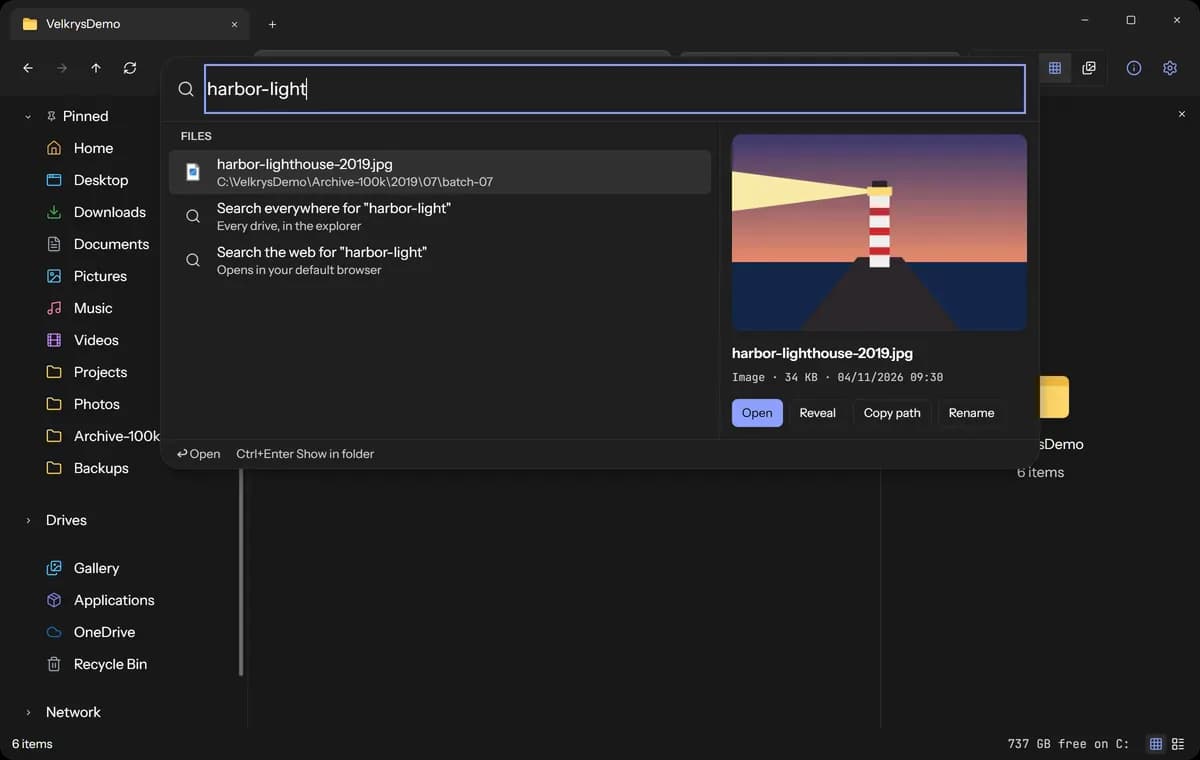
Velkrys is a free, open-source file explorer built by our CTO Joy Ahmed. It finds any file in a keystroke, opens archives like folders, and has no tracking. Here is what it does and what we tested on Linux this week.
2026-11-15
Someone broke into our server in November. Here is how I threw them out and rebuilt it in under 5 hours.
An attacker used the Next.js bug React2Shell (CVE-2025-55182) against one of our sites. I traced every step, rebuilt the server from a blank install in 4 hours 20 minutes, and it now watches back.
2025-05-15
Why Learning to Code is Essential in the Age of AI (And How ZettaByte Empowers You)
As AI reshapes tech, coding remains a critical skill. Discover why human ingenuity thrives alongside AI and how ZettaByte prepares learners for the future.💡💻